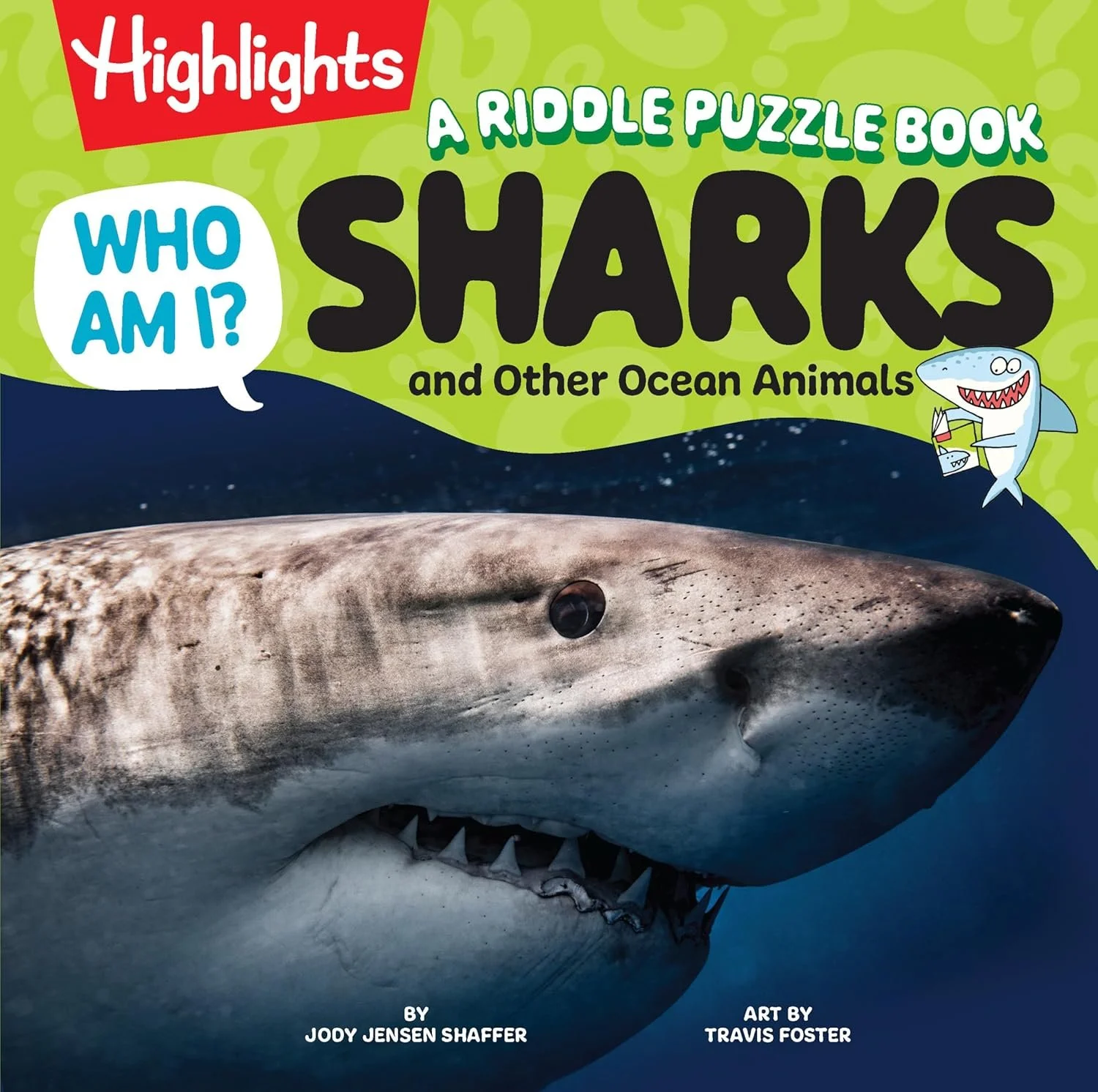
WHO AM I? SHARKS AND OTHER OCEAN ANIMALS
Download a standards-aligned dinosaur and fossils lesson guide with fact vs fiction activities, inquiry-based learning, and science-writing integration for elementary students.
Helping Kids Discover the Ocean Through Clues, Curiosity, and Play: A Classroom Experience Inspired by Who Am I? Sharks and Other Ocean Animals
Have you ever watched kids try to guess something?
They lean in.
They notice details.
They start thinking out loud.
“Wait… it has fins…”
“No—maybe it glows!”
“Oh! I know what it is!”
They’re not just guessing.
They’re thinking.
That’s exactly what Who Am I? Sharks and Other Ocean Animals invites them to do—and what this guide helps you turn into meaningful learning.
Book Snapshot
Title:Who Am I? Sharks and Other Ocean Animals
Author: Jodi Jensen Shaffer
Illustrator: Travis Foster
Publisher: Highlights Press
Age Range: Grades PK–3
Genre: Informational / Riddle-Based Science
Themes: Ocean Life, Animal Adaptations, Habitats, Inquiry, Observation, Critical Thinking
A Book Built on Clues
This book turns learning into a game.
Each page invites students to listen carefully, think deeply, and solve a riddle using clues about ocean animals.
Not just:
👉 “Here’s a shark”
But:
👉 “I have sharp teeth… I swim fast… Who am I?”
And in that moment, everything shifts.
Students aren’t just receiving information.
They’re analyzing it.
Testing ideas.
Making connections.
They’re thinking like scientists.
Why This Book Matters (Especially in Early Science Learning)
If you’ve ever found yourself:
Trying to keep young learners engaged during science
Looking for ways to make content interactive—not passive
Teaching vocabulary like habitat and adaptation in a meaningful way
Wanting students to observe, compare, and explain—not just memorize
…this book opens that door.
Because it transforms learning into discovery.
And as the guide reinforces, each riddle becomes an opportunity to explore how animals survive, where they live, and why their features matter .
What Students Learn (Without Even Realizing It)
Through this experience, students begin to:
Understand animal adaptations and how they support survival
Explore ocean habitats and zones
Compare and classify animals based on features
Develop observation and reasoning skills
Use evidence to support their thinking
Build vocabulary in a natural, engaging way
They begin to see that every detail matters…
…and that clues can lead to understanding.
Bringing the Book to Life in Your Classroom
To extend this learning, I created a Discussion & Project Guide that turns riddles into real science thinking.
Inside, you’ll find:
Scaffolded discussion questions (noticing → connecting → applying → reflecting)
Hands-on sorting activities using ocean animal cards
A visual, interactive Ocean Zones in a Bottle experiment
Creative riddle-writing and drawing projects
Printable materials for easy implementation
For example, in the Ocean Zones in a Bottle activity, students build a layered model of the ocean using liquids—connecting density to real ocean zones like Sunlight, Twilight, and Midnight (pages 9–12) .
A Simple Way to Use This in Your Week
Here’s a flexible, engaging flow:
Day 1: Read riddles + make predictions
Day 2: Discuss adaptations and habitats
Day 3: Sort and compare ocean animals
Day 4: Build “Ocean Zones in a Bottle”
Day 5: Write and share original riddles
It’s interactive, hands-on, and easy to implement.
Standards Alignment
This resource naturally supports:
Common Core State Standards (CCSS):
Speaking, listening, and discussion
Informational text comprehension
Vocabulary development
Next Generation Science Standards (NGSS):
Structure and function (adaptations)
Habitats and survival
Scientific reasoning and explanation
Social-Emotional Learning (SEL):
Curiosity and engagement
Collaboration and discussion
Confidence in sharing ideas
The guide intentionally integrates all of these through play, inquiry, and reflection .
Grab the Discussion & Project Guide
If you’re looking for a way to turn play into powerful science learning:
👉 Download the Who Am I? Sharks and Other Ocean Animals Guide
Want to Add the Book to Your Collection?
👉 Purchase Who Am I? Sharks and Other Ocean Animals here
Note: As an Amazon Associates I earn from qualifying purchases.
A Final Thought
What I love most about this book…
…is how it slows kids down just enough to notice.
To look closer.
To think deeper.
To wonder why.
And in that space between clue and answer…
learning happens.
This guide is part of my Guides by Deb collection—standards-aligned resources designed to help educators turn great books into meaningful learning experiences.
I’m Debbie Gonzales, author, educator, and founder of Pin Lit Marketing, where I help children’s book creators grow their visibility through Pinterest.
Together, this work connects books, educators, and readers in lasting ways.