Who Am I? Axolotls and Other Amphibians
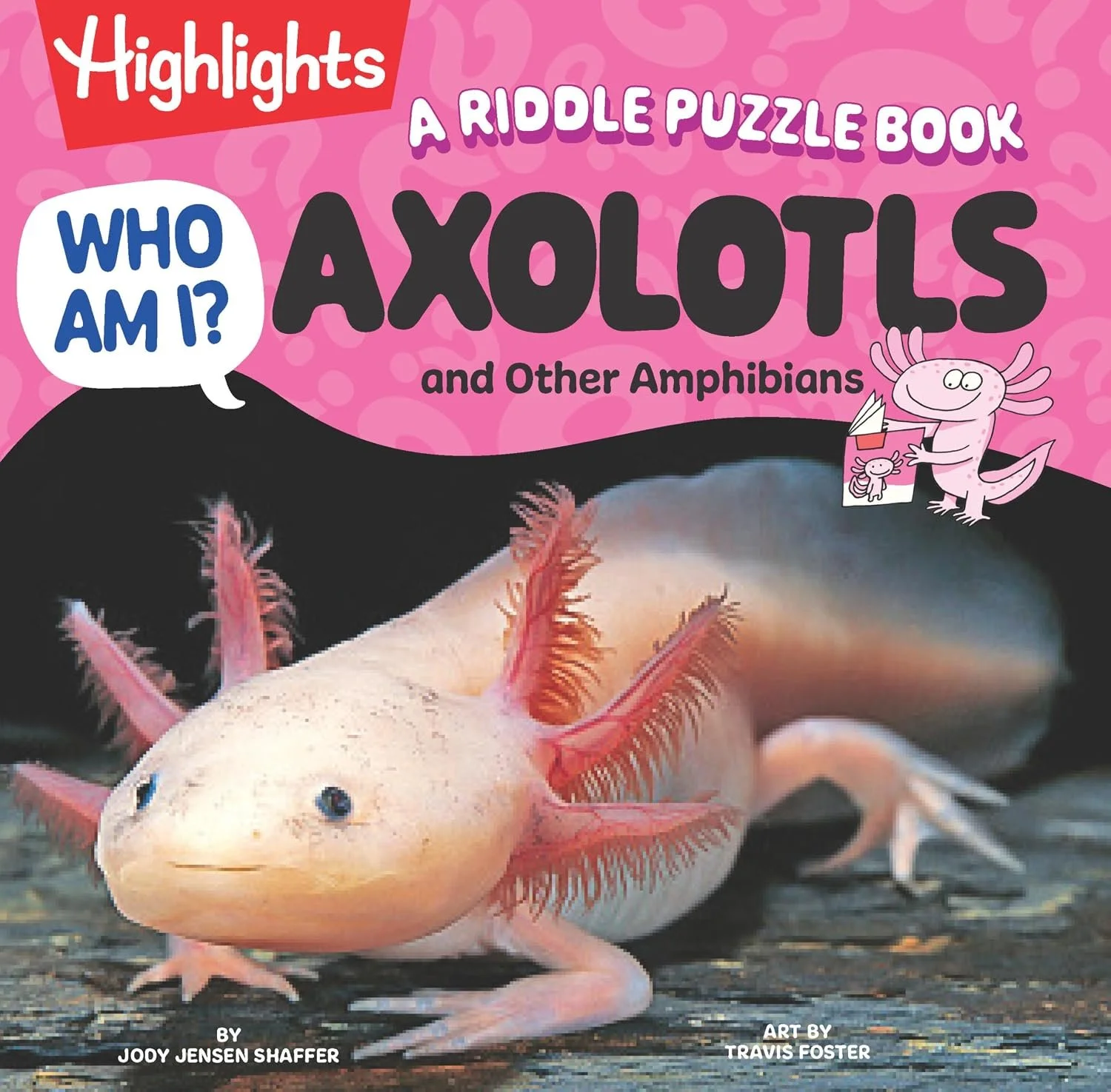
Some animals practically beg children to ask questions.
An axolotl is one of them.
Those feathery gills.
That curious little face.
The fact that it can regrow a lost limb.
Seriously? How can you not want to know more?
That sense of wonder is exactly what makes Who Am I? Axolotls and Other Amphibians such fun.
But underneath all the weird and wonderful is some pretty fascinating science.
What if those unusual body parts and behaviors are there for a reason?
Now we've got a question worth investigating.
Book Snapshot
Title: Who Am I? Axolotls and Other Amphibians
Author: Jodi Jensen Shaffer
Illustrator: Travis Foster
Publisher: Highlights Press
Age Range: Ages 4–8 / Grades PK–3
Genre: Interactive Nonfiction / STEM
Themes: Amphibians, Animal Adaptations, Habitats, Survival, Defense Strategies, Scientific Thinking
This playful read-aloud pairs rhyming riddles with tricky, distorted photographs that challenge children to identify an animal before the page-turn reveal. From axolotls to red-eyed tree frogs, the answers are accompanied by fascinating, expert-reviewed facts.
When “That's Weird!” Becomes “I Wonder Why?”
Young children are wonderfully curious about unusual things.
And amphibians give them plenty to wonder about.
Why does an axolotl have feathery gills?
How does a tree frog hang onto a leaf?
Why would an animal want to be brightly colored when predators are nearby?
How can a bullfrog breathe through its skin?
The book introduces children to adaptations including feathery gills, webbed feet, sticky toe pads, extra eyelids, poisonous skin, camouflage, and other features that help amphibians swim, climb, hide, hunt, and stay safe.
And suddenly, “weird” becomes a science lesson.
Why This Book Works So Well in the Classroom
If you're looking for ways to:
Introduce animal adaptations to young learners
Explore habitats and how animals meet their needs
Practice observation and evidence-based thinking
Connect informational text with creative writing
Introduce structure and function in an age-appropriate way
Make science vocabulary memorable
Get children talking, wondering, guessing, and asking questions
…this book gives you a terrific place to begin.
The riddles naturally invite children to slow down and look for evidence.
What did you notice?
Which clue mattered?
What does that body part do?
Could another animal fit those clues?
Did you change your mind? Why?
Those are reading-comprehension questions.
But they're also scientific-thinking questions.
What Students Learn (While Solving the Mystery)
Through the book and companion guide, children investigate:
Animal adaptations
Amphibian habitats
Defense strategies
Predator and prey relationships
Structure and function
Comparing and contrasting animal traits
Using evidence to support an idea
Scientific vocabulary
Observation, prediction, and reasoning
The discussion portion intentionally moves students through noticing → connecting → applying → reflecting, preparing them to use what they've discovered in the hands-on lessons that follow.
And there are some wonderfully memorable facts to work with.
Axolotls can regrow lost limbs. Bullfrogs can jump six feet. Poison dart frogs use bright colors as a warning. Cane toads can lay thousands of eggs. Red-eyed tree frogs can flash those spectacular eyes to startle danger away.
Try getting a room full of young scientists to forget those facts!
Bringing the Book to Life in Your Classroom
To keep all that curiosity going, I created a companion Discussion & Project Guide for grades PK–3.
The guide takes students through three different experiences—each one asking them to use information from the book in a new way.
Amphibian Detectives: Solve the Clue Case
Grab your magnifying glasses. We've got a case to solve!
Students become amphibian detectives, using clues about body parts, habitats, behaviors, food, movement, and defense strategies to identify mystery animals.
The important part isn't simply making the correct guess.
Students have to explain how they know.
The activity encourages language such as:
“I noticed…”
“The clue said…”
“That matches…”
“I changed my mind because…”
The lesson makes the connection beautifully clear:
Clues + Close Looking + Evidence = Smart Detective Thinking.
Write an Amphibian “Who Am I?” Riddle
Next, the scientists become writers.
Using Who Am I? Axolotls and Other Amphibians as a mentor text, students explore how authors use facts, descriptive language, clues, rhythm, and rhyme to teach readers something while entertaining them.
Children select an amphibian and gather clues about its body parts, habitat, movement, behavior, or defense strategies before creating a riddle of their own.
Emerging writers can use simple sentence frames, while students ready for more challenge can experiment with stronger descriptive language, rhyming words, and clues that don't reveal the answer too quickly.
Science has just become a writing lesson, too.
Create an Amphibian Super-Survivor
And then we really have some fun.
Students use everything they've learned to invent a brand-new amphibian.
But there's a catch.
Their creature has to make scientific sense.
If it lives in water, what body parts will help it survive there?
If it lives in trees, how will it climb?
What will it eat?
How will it hide?
How will it protect itself from predators?
Students choose a habitat, adaptations, food source, and defense strategy, then draw and label their original amphibian and explain how its features help it survive.
This isn't creativity instead of science.
The creativity demonstrates the science.
A Simple Way to Use This in Your Week
Here's one possible classroom rhythm:
Day 1: Read, guess, reveal + discuss amazing amphibian adaptations
Day 2: Become Amphibian Detectives and solve the mystery clue cases
Day 3: Study the book as a mentor text + plan a “Who Am I?” riddle
Day 4: Write and share amphibian riddles
Day 5: Design an Amphibian Super-Survivor + explain how it survives
You can adapt the activities for the age and needs of your students, but I love the progression.
First they investigate. Then they write. Then they create.
Standards Alignment
The guide intentionally brings literacy, science, and social-emotional learning together through discussion, inquiry, wordplay, and hands-on activities.
Common Core State Standards (CCSS):
Informational reading and comprehension
Speaking & Listening
Using text and illustrations as evidence
Informative and imaginative writing
Vocabulary development
Presenting and explaining ideas
Next Generation Science Standards (NGSS):
Animal structures and survival
Animal needs and environments
Comparing animals across different habitats
Analyzing and interpreting information
Constructing explanations
Developing and using models
In fact, the students' Super-Survivor drawings function as simple scientific models: children connect habitat, body parts, movement, food, and defense to demonstrate how their invented amphibian could survive.
Social-Emotional Learning (SEL):
Responsible decision-making
Relationship skills
Self-management
Self-awareness
Social awareness
Students collaborate, listen to different ideas, revise their thinking, make purposeful choices, and develop confidence in sharing their own creations.
That's a whole lot of learning packed inside one very curious little pink creature.
Grab the Free Discussion & Project Guide
Ready to turn amphibian curiosity into hands-on science and literacy learning?
Download the complete CCSS & NGSS-aligned Discussion & Project Guide for grades PK–3 here:
[Download the Who Am I? Axolotls and Other Amphibians Discussion & Project Guide]
Inside you'll find discussion prompts, Amphibian Detective mystery cases, riddle-writing resources, an Amphibian Super-Survivor project, student printables, answer resources, and educational standards alignment.
Want to Add the Book to Your Collection?
[Purchase Who Am I? Axolotls and Other Amphibians here!]
Note: As an Amazon Associate I earn from qualifying purchases.
A Final Thought
There is something wonderfully disarming about an axolotl.
Maybe it's that little face.
Maybe it's those feathery gills.
Maybe it's discovering that this almost otherworldly-looking creature is beautifully equipped to live exactly the life it lives.
That's what I love about using a book like this with young learners.
We begin with:
“Whoa! Look at that!”
Then comes:
“How does it do that?”
And eventually:
“Why does it need that?”
That little shift—from surprise to curiosity to understanding—is where some of the very best learning happens.
Wonder opens the door. Science invites us through it.
This guide is part of my Guides by Deb collection—standards-aligned resources designed to help educators turn great books into meaningful learning experiences.
I’m Debbie Gonzales, author, educator, and founder of Pin Lit Marketing, where I help children’s book creators grow their visibility through Pinterest.
Together, this work connects books, educators, and readers in lasting ways.