Who Am I? Tigers and Other Big Cats
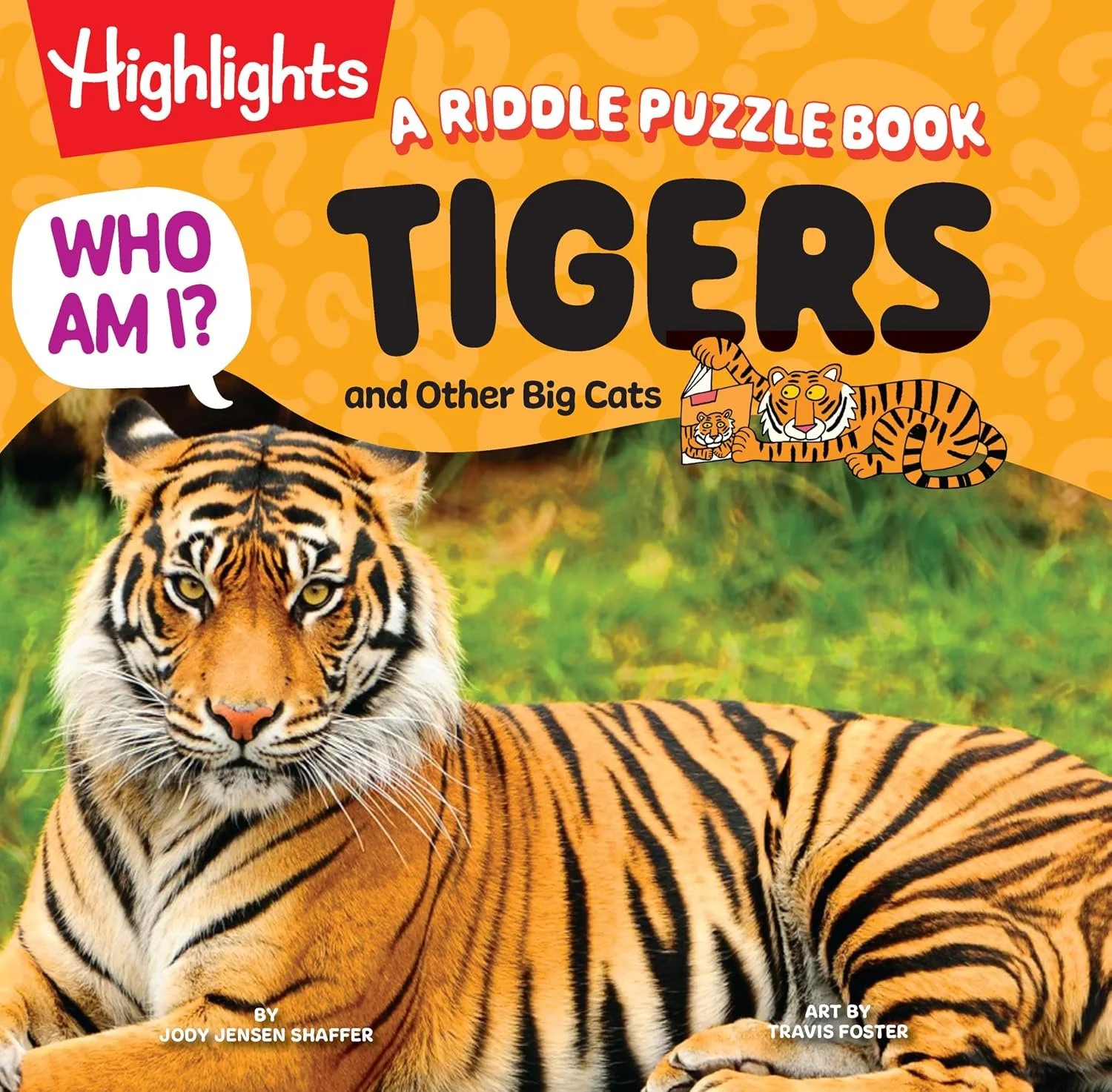
There is something irresistible about a mystery.
Give young learners a few clues, a puzzling picture, and the chance to shout, “I KNOW!” and suddenly everyone is paying attention.
That’s the magic behind Who Am I? Tigers and Other Big Cats.
But here’s what I especially love about this book:
The guessing is only the beginning.
Once children discover who the animal is, we can start asking bigger questions.
How does it survive?
Where does it live?
What does it eat?
How do its body parts help it hunt, hide, run, or stay safe?
And just like that, a riddle becomes a doorway into science.
Book Snapshot
Title: Who Am I? Tigers and Other Big Cats
Author: Jodi Jensen Shaffer
Illustrator: Travis Foster
Publisher: Highlights Press
Age Range: Grades PK–3
Genre: Interactive Nonfiction / STEM
Themes: Big Cats, Animal Adaptations, Habitats, Ecosystems, Predators & Prey, Scientific Thinking
The book combines rhyming riddles and difficult-to-decipher photographs with page-turn reveals, illustrations, and facts about tigers, lions, cheetahs, leopards, and other big cats.
A Guessing Game That Gets Kids Thinking Like Scientists
What makes this book so much fun is that children aren't simply being given information.
They have to look.
Listen.
Notice.
Predict.
And then revise their thinking when new information appears.
That makes Who Am I? Tigers and Other Big Cats a natural springboard for the kind of thinking we want young scientists to practice.
The accompanying discussion guide builds on that beautifully by moving children through a progression of noticing → connecting → applying → reflecting as they explore animal adaptations, habitats, ecosystems, and predator-prey relationships.
Why This Book Works So Well in the Classroom
If you're looking for ways to:
Make nonfiction read-alouds more interactive
Introduce animal adaptations and habitats
Teach predator and prey relationships
Help children practice observation and classification
Encourage students to explain their thinking
Connect science with reading, writing, and creativity
…this book gives you plenty to work with.
Children may think they're solving riddles.
Meanwhile, they're gathering evidence, making predictions, comparing characteristics, learning science vocabulary, and using new information to reconsider their ideas.
Sneaky learning at its best.
What Students Learn (While Having a Really Good Time)
Through the book and companion activities, students explore:
Animal adaptations and how they support survival
Habitats and ecosystems
Predator and prey relationships
How animals depend upon food, water, shelter, and space
Comparing and contrasting animal characteristics
Sorting and classification
Using evidence to explain an idea
Connecting physical structures with their functions
The guide also encourages children to think beyond memorizing facts. They consider what might happen if an animal moved to a different habitat, prey became scarce, or an ecosystem changed.
Bringing the Book to Life in Your Classroom
To extend all that wonderful curiosity, I created a companion Discussion & Project Guide for grades PK–3.
Inside, you'll find discussion prompts and three hands-on learning experiences that take children progressively deeper into the science behind the riddles.
Predator & Prey: What Do Tigers Eat?
Students use animal cards to decide which animals might—or might not—be tiger prey. But the important part isn't simply getting the answer right. Children are encouraged to explain why they made their choices using size, habitat, behavior, and evidence from the book.
Tigers & Territories: Building a Predator's Home
Next, students become habitat designers. They create a tiger-territory diorama containing the things a tiger needs to survive—including prey, water, shelter, hiding places, and space.
Create Your Own Predator & “Who Am I?” Riddle
And this may be my favorite! Children invent their own predator, choose physical adaptations that will help it survive, draw and label their creature, and then write a riddle based on its adaptations, abilities, and habitat.
Science + literacy + creativity. Yes, please!
A Simple Way to Use This in Your Week
Here's one possible classroom rhythm:
Day 1: Read, guess, reveal + discuss big-cat adaptations
Day 2: Predator or Prey? sorting and reasoning activity
Day 3: Explore habitats + plan a tiger territory
Day 4: Build and share tiger-territory dioramas
Day 5: Create an original predator + write a “Who Am I?” riddle
You could certainly shorten or extend the experience depending on the age of your students.
The important thing is that each activity returns children to the same big idea:
An animal's body, behavior, habitat, and survival are all connected.
Standards Alignment
This guide was intentionally designed to connect science, literacy, and social-emotional learning.
Common Core State Standards (CCSS):
Informational reading and comprehension
Speaking & Listening
Using text and illustrations to understand ideas
Informative and creative writing
Vocabulary development
Presenting and explaining ideas
Next Generation Science Standards (NGSS):
What animals need to survive
Relationships between animals and their environments
Comparing life in different habitats
Developing and using models
Analyzing and interpreting information
Connecting structure and function
The tiger-territory diorama, for example, functions as a scientific model of an ecosystem, while the original-predator project asks students to connect a body part with its function and explain how that adaptation supports survival.
Social-Emotional Learning (SEL):
Responsible decision-making
Self-management
Self-awareness
Social awareness
Relationship skills
Students explain their reasoning, listen to other ideas, revise their thinking, complete multi-step projects, and share their creations with others.
In other words: we're doing a whole lot more than learning that tigers have stripes.
Grab the Free Discussion & Project Guide
Ready to turn those big-cat riddles into hands-on STEM learning?
You can download the complete 25-page, CCSS & NGSS-aligned Discussion & Project Guide for grades PK–3 here:
[Download the Who Am I? Tigers and Other Big Cats Discussion & Project Guide]
The guide includes discussion questions, lesson plans, prey-animal cards, sorting activities, predator-design printables, riddle-writing pages, and complete educational standards alignment.
Want to Add the Book to Your Collection?
[Purchase Who Am I? Tigers and Other Big Cats here!]
Note: As an Amazon Associate I earn from qualifying purchases.
A Final Thought
I love books that make children curious before they even realize they're learning.
Who Am I? Tigers and Other Big Cats does exactly that.
It begins with a simple invitation:
Can you solve the riddle?
But once children start looking closely, the questions get bigger.
Why does that animal have those particular body parts?
How do they help it survive?
Why does it live there?
What does it need from its environment?
And eventually, perhaps the most interesting question of all:
What would happen if I designed a predator of my own?
That's when children stop simply receiving information and start using what they've learned to create something new.
And that's the kind of learning that sticks.
This guide is part of my Guides by Deb collection—standards-aligned resources designed to help educators turn great books into meaningful learning experiences.
I’m Debbie Gonzales, author, educator, and founder of Pin Lit Marketing, where I help children’s book creators grow their visibility through Pinterest.
Together, this work connects books, educators, and readers in lasting ways.