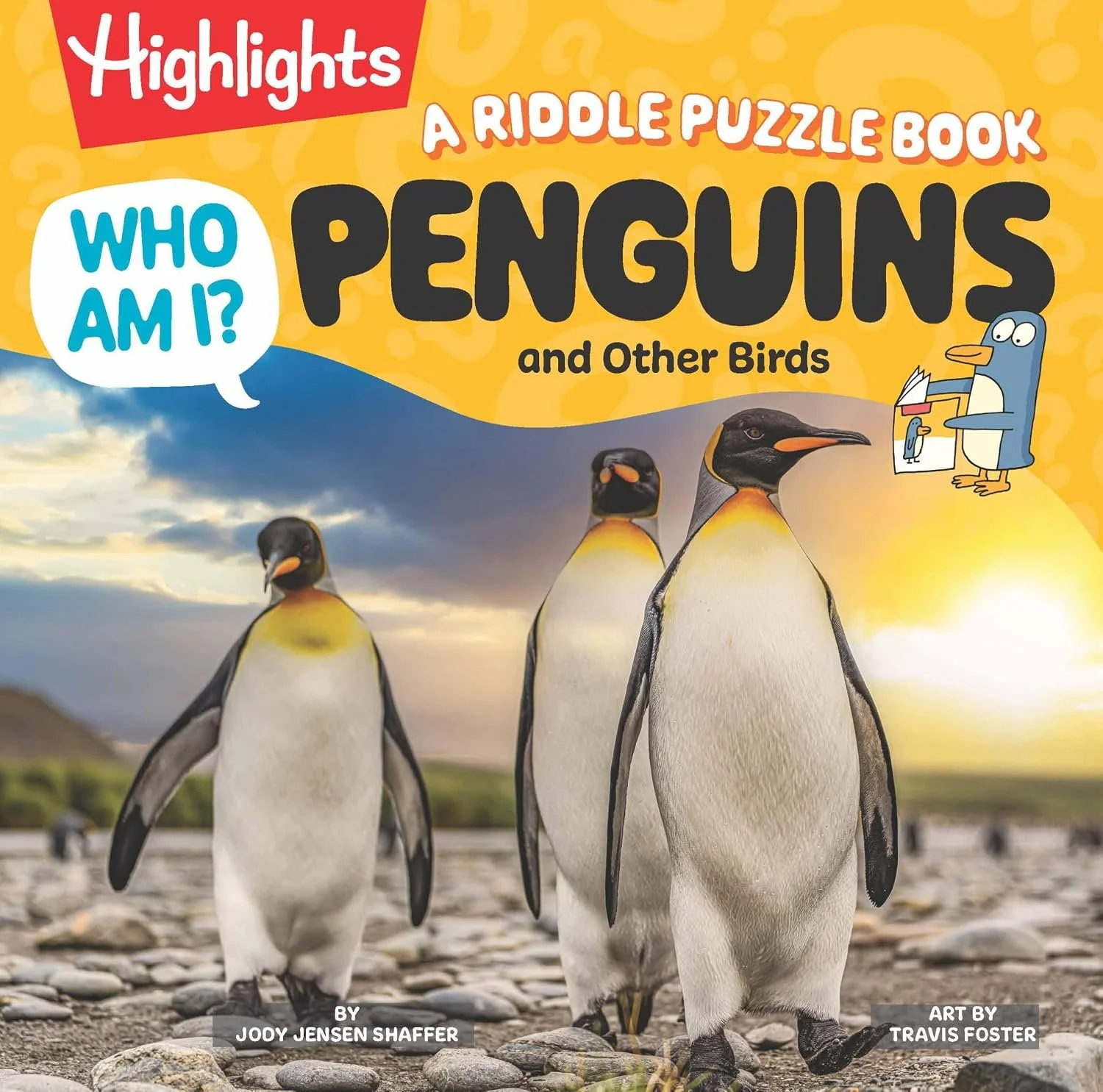
WHO AM I? PENGUINS AND OTHER BIRDS
What Can a Bird’s Beak Tell Us? A Hands-On Science Adventure with Who Am I? Penguins and Other Birds
Some birds practically dare children to figure them out.
A penguin is one of them.
Those wings that don’t really fly.
That upright waddle.
Those feet.
And then—wait a minute—it uses those wings to swim?
How can you not want to know more?
That sense of discovery is exactly what makes Who Am I? Penguins and Other Birds such fun.
But once children begin looking closely, something even more interesting happens.
They start noticing that birds aren't all built the same way.
Why?
Now there’s a question worth investigating.
Book Snapshot
Title: Who Am I? Penguins and Other Birds
Author: Jodi Jensen Shaffer
Illustrator: Travis Foster
Publisher: Highlights Press
Age Range: Ages 4–8 / Grades PK–3
Genre: Interactive Nonfiction / STEM
Themes: Birds, Animal Adaptations, Habitats, Structure & Function, Animal Behavior, Movement, Scientific Thinking
This playful nonfiction book pairs rhyming riddles and distorted photographs with a page-turn reveal. Children study the clues, make a prediction, and then discover vivid wildlife photography and bite-sized science facts about penguins, owls, hummingbirds, flamingos, parrots, goldfinches, and other remarkable birds. Who Am I Penguins & Other Birds…
And that guessing-game format does something pretty wonderful.
It gets children looking for evidence before they even realize they're doing science.
When “What Bird Is That?” Becomes “Why Is It Built That Way?”
Birds are wonderfully different.
A penguin uses its wings like flippers.
An owl can fly quietly enough to sneak up on prey.
A hummingbird can hover.
A flamingo wades through shallow water.
A parrot can use its beak to help it climb.
Suddenly, a beak isn't simply a beak.
A wing isn't simply a wing.
And feet aren't just feet.
Each structure can give us clues about how a bird moves, what it eats, where it lives, and what it needs to survive. That's one of the central ideas explored throughout the companion guide. Who Am I Penguins & Other Birds…
And suddenly:
“Look at that bird!”
becomes:
“Why does it have that kind of beak?”
Now we're doing science.
Why This Book Works So Well in the Classroom
If you're looking for ways to:
Introduce animal adaptations and structure and function
Explore bird habitats, food, movement, and behavior
Practice observation, prediction, and evidence-based reasoning
Compare how animals meet their needs
Connect informational reading with hands-on science
Introduce scientific modeling and simple engineering thinking
Get children looking closely, wondering, testing, and explaining
…this book gives you a terrific place to begin.
The riddle format naturally encourages children to slow down and gather information.
What did you notice?
Which clue helped you most?
What does that bird do?
What can its body tell us?
Does your evidence support your guess?
Did you change your mind?
Those are reading-comprehension questions.
But they're also the kinds of questions scientists ask.
What Students Learn (While Solving the Mystery)
Through the book and companion guide, children investigate:
Bird body parts and adaptations
Structure and function
Beaks, feet, and feeding
Flying, swimming, hovering, and other kinds of movement
Habitats, homes, and nests
Migration and seasonal change
Animal behavior
Observation and prediction
Using evidence to support an idea
Scientific modeling and design
The discussion portion intentionally moves students through noticing → connecting → applying → reflecting, giving them opportunities to build understanding before using what they've discovered in the hands-on projects. Who Am I Penguins & Other Birds…
And the birds give us some fabulous material to work with.
Penguins swim with their wings. Owls have specialized feathers that help them fly quietly. Hummingbirds hover. Flamingos have long legs suited to wading. Different birds have different strengths because they live very different lives. Who Am I Penguins & Other Birds…
Try getting a room full of young scientists to look at a bird the same way again.
Bringing the Book to Life in Your Classroom
To keep all that bird curiosity going, I created a companion CCSS & NGSS-Aligned Discussion & Project Guide for grades PK–3.
The guide takes students through three hands-on experiences, each asking them to use what they've discovered about birds in a different way. The projects build from investigation, to evidence gathering, to scientific design. Who Am I Penguins & Other Birds…
Bird Beak Café — Which Tool Does the Job?
Welcome to the café.
But today, nobody gets a fork.
Students experiment with classroom-safe tools—such as spoons, tweezers, clothespins, and tongs—and use them as pretend bird beaks to collect different kinds of “food.”
Which tool works best for scooping?
Which one can grasp something tiny?
What happens when the shape of the “beak” isn't particularly well suited to the food?
Students predict, test, observe, record results, and then connect their findings back to real birds. The investigation introduces one of the most important ideas in life science:
Structure is how something is built.
Function is the job it does.
And those two things are connected. Who Am I Penguins & Other Birds…
Suddenly a bird's beak becomes much more than something pointy on the front of its face.
It's a tool.
Bird Behavior Detectives — Follow the Clues
Next, we're putting on our detective hats.
This time, students aren't concentrating only on what a bird has.
They're investigating what a bird does.
Does it swim?
Hunt at night?
Hover?
Migrate?
Climb?
Wade through water?
Students work through Bird Behavior Detective case files, gathering behavioral evidence to identify mystery birds.
But—as any good detective knows—the answer alone isn't enough.
Where's your evidence?
Students are encouraged to explain their reasoning:
“I think it is _____ because _____.”
“The clue that helped me was _____.”
“I changed my mind when I learned _____.”
That's where this becomes more than a guessing game. Students learn to make a claim, support it with evidence, and revise their thinking when new information changes what they know. Who Am I Penguins & Other Birds…
The detective formula says it all:
Observe + Gather Clues + Use Evidence = Bird Behavior Detective. Who Am I Penguins & Other Birds…
Build-a-Bird — The Habitat Challenge
And then comes the grand finale.
Students invent a bird.
But there's a catch.
They can't just make it look cool.
Their bird has to make scientific sense.
Students draw a Habitat Challenge Card that might send their imaginary bird to an icy coast, a forest at night, a flower-filled garden, a shallow wetland, or an open woodland. Who Am I Penguins & Other Birds…
Then the questions begin.
What will it eat?
What kind of beak will help it get that food?
What will its feet need to do?
How will its wings help it move?
What kind of feathers will it need?
Where will it rest or raise its young?
What behavior will help it survive?
Students plan, draw, label, and explain their original bird as a simple scientific model. Then a partner reviews the design, identifies a feature that makes sense, and asks a question that may prompt the designer to revise the model. Who Am I Penguins & Other Birds…
This isn't creativity instead of science.
The creativity demonstrates the science.
And I love that.
A Simple Way to Use This in Your Week
Here's one possible classroom rhythm:
Day 1: Read, guess, reveal + discuss bird body parts and adaptations
Day 2: Open the Bird Beak Café and investigate structure and function
Day 3: Become Bird Behavior Detectives and solve the clue cases
Day 4: Explore habitats and begin the Build-a-Bird Challenge
Day 5: Finish the scientific models + partner review + Built-for-the-Job Bird Show
Of course, teachers can stretch the projects across several days or adapt them for younger students through read-alouds, drawing, modeling, and adult-supported responses.
But I especially love the progression.
First they notice.
Then they investigate.
Then they use evidence.
Finally, they create.
Standards Alignment
The guide intentionally brings literacy, science, and social-emotional learning together through discussion, hands-on investigation, evidence-based reasoning, and creative design. It supports grades K–3 and can be adapted for preschool learners. Who Am I Penguins & Other Birds…
Common Core State Standards (CCSS):
Informational reading and comprehension
Asking and answering questions using text evidence
Connecting photographs, illustrations, and written information
Speaking and listening
Informative writing and explanation
Scientific vocabulary
Presenting ideas with drawings and visual displays
Next Generation Science Standards (NGSS):
Animal needs and survival
Structure and function
Patterns in animal structures and behaviors
Planning and carrying out investigations
Analyzing and interpreting observations
Developing and using models
Constructing explanations
Designing solutions
Engaging in argument from evidence
The Bird Beak Café, for example, asks children to compare how different “beak” tools solve the same food-gathering problem. The Build-a-Bird project asks them to create a model connecting an animal's needs to its habitat and to explain how particular structures help it function. Who Am I Penguins & Other Birds…
Social-Emotional Learning (SEL):
Self-awareness
Social awareness
Self-management
Responsible decision-making
Relationship skills
Students listen to other ideas, persist through tricky investigations, evaluate evidence, make purposeful design choices, offer constructive feedback, and revise their thinking when necessary. Who Am I Penguins & Other Birds…
That's a whole lot of learning hiding underneath a few feathers.
Grab the Free Discussion & Project Guide
Ready to turn bird watching into bird wondering?
Download the complete CCSS & NGSS-Aligned Who Am I? Penguins and Other Birds Discussion & Project Guide for grades PK–3.
Inside you'll find scaffolded discussion prompts, the Bird Beak Café investigation, Bird Behavior Detective case files, Habitat Challenge Cards, Build-a-Bird planning and design printables, partner review materials, answer resources, and educational standards alignment. The guide was designed to help young learners think like scientists, communicate like readers and writers, and grow as thoughtful, curious individuals. Who Am I Penguins & Other Birds…
[Download the Who Am I? Penguins and Other Birds Discussion & Project Guide]
Want to Add the Book to Your Collection?
[Purchase Who Am I? Penguins and Other Birds here!]
Note: As an Amazon Associate I earn from qualifying purchases.
A Final Thought
There is something wonderful about watching a child realize that an animal's body tells a story.
At first, they see:
A funny beak.
A pair of long legs.
Tiny wings beating impossibly fast.
A penguin waddling across the ice.
But look a little longer and the questions change.
“What does that beak do?”
“Why are its legs so long?”
“How can it hover?”
“Why does a penguin have wings if it doesn't fly?”
And eventually:
“Oh! It's built that way because…”
There it is.
That tiny moment when noticing becomes reasoning.
When a child realizes that the shape of a beak, the movement of a wing, the length of a leg, or the behavior of a bird isn't random at all.
It belongs to a bigger story about habitat, need, structure, function, and survival.
And once children begin seeing animals that way, the natural world becomes one enormous mystery waiting to be investigated.
Wonder gets them looking.
Evidence keeps them investigating.
Science helps them understand what they see.
This guide is part of my Guides by Deb collection—standards-aligned resources designed to help educators turn great books into meaningful learning experiences.
I’m Debbie Gonzales, author, educator, and founder of Pin Lit Marketing, where I help children’s book creators grow their visibility through Pinterest.
Together, this work connects books, educators, and readers in lasting ways.
This guide is part of my Guides by Deb collection—standards-aligned resources designed to help educators turn great books into meaningful learning experiences.
I’m Debbie Gonzales, author, educator, and founder of Pin Lit Marketing, where I help children’s book creators grow their visibility through Pinterest.
Together, this work connects books, educators, and readers in lasting ways.